
Group retirement plans are what I want to focus on with this post. It seems like more and more people are either retiring, changing jobs, or becoming unemployed. For most, their group retirement plan is the lion’s share of their investments. For simplicity’s sake, I’m going to use 401k as a ubiquitous term for a group retirement plan. There are some nuances between other types, but most people have either a 403b, 401k, or in some cases a 457b. When you terminate from employment you have options. Understanding them is crucial to long-term success. There are 3 basic things you can do with the funds after you leave your job, either willingly or forced out: Keep the money in the plan, withdraw the funds, or roll the money over.
Before we delve into your options, let’s review the general rules of retirement plans. You are eligible to withdraw funds penalty-free after you turn 59.5. If you are over that age, the amount withdrawn is taxed as ordinary income in Traditional 401ks funded with pretax dollars. These are often called tax deferred accounts. For Roth 401ks funded with after tax dollars there are no tax consequences on withdrawals after age 59.5. These are the same rules that apply to IRAs, both Traditional and Roth.
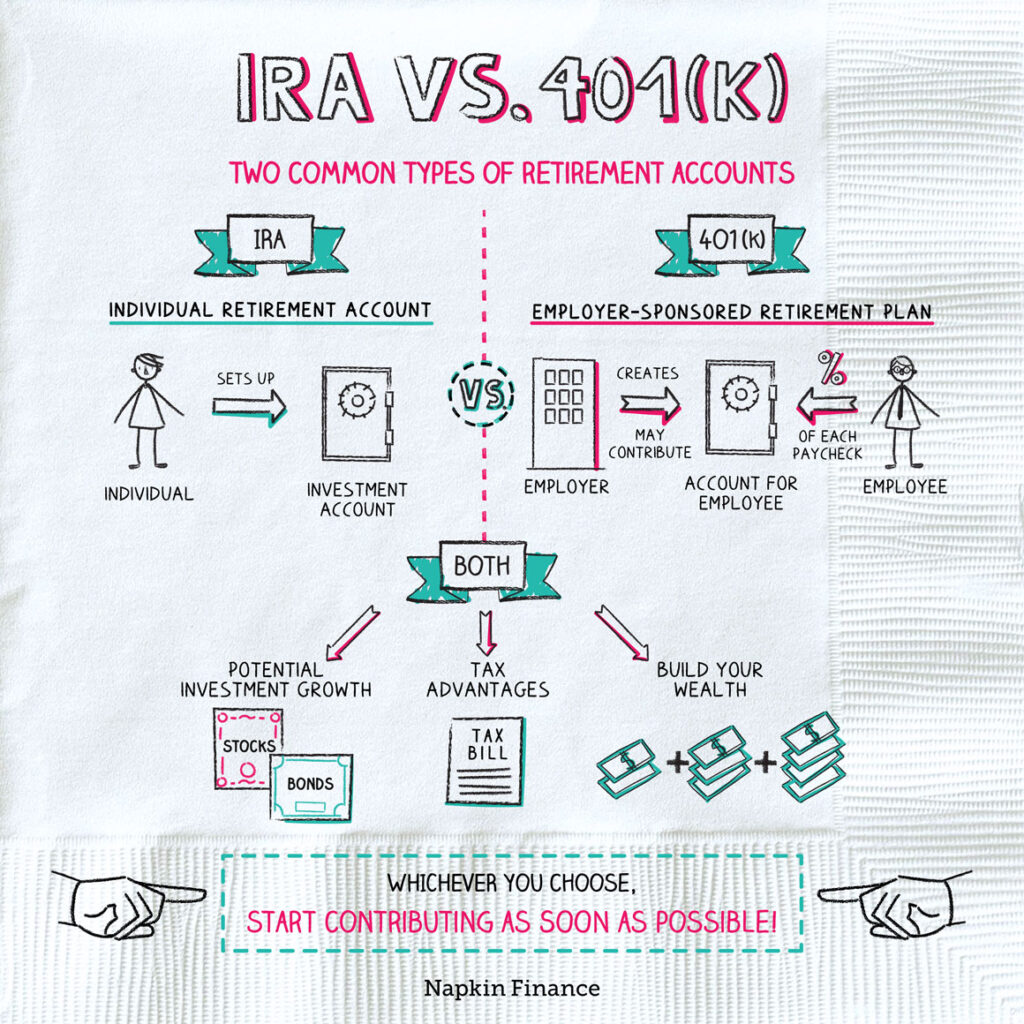
(Image courtesy of Napkinfinance.com)
There are a couple important differences between IRAs and 401ks though. IRAs are individual accounts and 401ks are tied to an employer. Some 401ks allow you to take loans against the amount, IRAs do not. One often overlooked benefit of a Traditional (pretax) 401k is that you can withdraw penalty free if you terminate from employment and are age 55 or older. IRAs do not offer this feature.
Knowing the basic rules, let’s go over your three options. The first option is to keep money in your old plan. Generally this is allowed unless you have a very small balance, typically $5000 or less. You’ll want to check with your plan administrator to see what their rules are. If it’s a small balance you may be forced to roll it out. But if you keep it where it is, you are eligible to withdraw 4.5 years earlier (age 55 vs 59.5) and you might be able to take a loan against your balance if the plan allows.
The second option is to withdraw the funds. This means you take money out of the tax sheltered plan and presumably spend it. This will create a taxable event for pre tax 401ks. This may be a good idea though if you need the funds. If you are under 55 you will pay a 10% penalty in addition to taxes on your pretax 401k unless you qualify for a hardship distribution. That 10% might not seem like much, but it really can impact your long term success. If it’s a Roth 401k the amount of the gain will be taxed and assessed as a 10% penalty if you withdraw before age 59.5. There’s no age 55 withdrawal provision for the Roth 401k. For example, if your Roth 401k is worth $200,000 and contributions amount to $100,000, you have a gain of $100k. If you are under age 59.5 you will be taxed and penalized on the $100,000 gain, not the original investment. Roth 401k withdrawals will come from your principal amount first which may not result in any tax if you only take out a portion.
The third option is to roll money over into your new plan or an IRA. If you move money to a new plan it just becomes part of your new 401k. That’s the simplest way to go for most people and simplicity is an overlooked commodity in the investment industry. I always like to point out that our desire for complexity diminishes with age! When rolling to your new 401k the money will maintain the characteristics of the new plan: fund lineup, potential loan provision, fees, etc. The only drawback I see with this option is that you lose the ability to withdraw at age 55 from a pretax account.
The second way you can roll money over is to roll it into an IRA. This is an individual account that completely separates it from a current or previous employer. Many times people will set up an IRA and use it as a vehicle to consolidate assets if they hop around jobs. In my opinion, the only drawbacks of doing this is you might want funds between age 55 and 59.5, and there is no loan provision for IRAs. The benefits of rolling to and IRA outweigh these drawbacks.
First, depending on your plan, 401ks can be expensive and the fees aren’t always transparent. I’ve worked with group plans for nearly 30 years and unless it’s affiliated with a large employer, the costs can be very high. IRAs vary in price from free to around 1% annually if you work with an advisor.
Investment flexibility is another drawback in 401k plans. You are generally limited to a fund menu which can significantly limit investment choices. Some plans allow for a self-directed option though which allows you to do a lot more. Oftentimes this is just an expanded mutual fund menu. IRAs allow you to invest in just about anything under the sun.
The biggest benefit of using an IRA is simplicity. People often have multiple plans floating around, sometime even through the advice of an advisor. It’s mind boggling to see people send over 7 or 8 different statements when they should have 2, maybe 3. There’s no need to overcomplicate things. Have an IRA rollover vehicle to consolidate plans and maybe a Roth IRA as well. This simplifies the withdrawal process. Once you reach age 73 you need to take required minimum distributions from your pretax accounts. Multiple IRAs or combinations of 401ks, 403bs and IRAs make this a nightmare.
In 401ks the employer typically needs to verify the withdrawal. For smaller plans this can be a cumbersome process with a lot of paperwork. For larger plans the process isn’t so bad, but still not as easy as taking money from your IRA. Maybe you left on bad terms and you don’t want your old employer to have anything to do with your retirement anymore? That’s something to consider.
Finally, 401ks are self-directed. Maybe you’re not comfortable making those decisions? Maybe you want the peace of mind of working with a professional? Maybe you have paralysis by analysis and can’t pull the trigger on basic things like rebalancing or making yourself more conservative? Any of these are reasons to not only use an IRA but seek help from an advisor.
As a financial advisor I make money when people roll into my firm. I’m a fiduciary so I must give advice that is in the client’s best interest, and we review all of these things prior to onboarding someone who has a 401k. Everybody’s analysis is a little different. Ask yourself what your goals are with the funds, what your current costs are and the potential costs associated with rolling over or withdrawing.
There is a lot more that could be covered here but it gets more complicated. Just remember your 3 main options with an old 401k. KISS (Keep It Simple Stupid) is a mantra for many things and should be applied here as well. The worst thing, in my opinion, a person can do is have multiple small accounts floating around. As an advisor I serve as a fixer these these types of problems. At some point those myriad accounts will need to be reconciled and that gets harder as time passes. Please reach out if you liked what you read or have questions about your own situation.
