
When I started Zetlmaier Wealth Management LLC (ZWM) I wanted to create a firm that cut out waste and passed value on to clients. Part of that value is billing as a “Flat Fee Advisor.” The term is newer but gaining traction due to firms like mine. I did a quick web search for “Flat Fee Advisors Seattle” and there are very few. Many who market themselves as flat fee offer financial planning services only; they don’t directly manage assets. Most of the results under flat fee are just fee-only advisors. What I do and what a handful of advisors nationwide do is planning and investment management for a specific, upfront, transparent cost. For this post, I want to cover what flat-fee is, why it isn’t more common, and why it is incredibly beneficial for clients.
What is Flat Fee?
The investment services industry charges either a commission or a percentage of investments managed. Commission is an entirely different topic so I’ll skip that. The percentage of assets is based on the amount invested and starts at 1%-1.25% annually and goes down from there. This is also known as the fee-only model. Under this model, let’s say you have $2,000,000 to invest. Many places will charge 1% of that amount, or $20,000 per year. If your account increases to $3,000,000 your fees increase to $30,000 per year. The industry sells this as “our interests are aligned, if you make money I make money.” Typically, the fee structure is tiered so you might pay 1% on the first $1 Million and 0.5% on anything above that. In this case the $2,000,000 portfolio is charged a more reasonable $15,000. At $3,000,000 it’s $20,000. Flat-fee caps this cost at a certain level. Mine is $10,000 per year.
The question consumers should always ask themselves is, am I getting (or perceiving) value for the fee paid? I argue that it is no harder to manage $10 Million than $1 Million. Think about it, the financial plan might be a little more complicated for a $10 Million dollar household but not roughly 5-10x more complicated that a $1 Million household. As for the actual management of investments, look at it this way: Is it harder to buy 100 shares of stock or 1000. Another way to think about it is, is it harder to count a stack of $100 bills or $1 bills?
Why aren’t there more flat fee advisors

This is because it isn’t as profitable for the advisor and more importantly it isn’t as profitable for large firms. I’m an independent advisor. I do all my own compliance, back office, investment management, etc. I trade and hold client assets with Charles Schwab who makes if very easy and cost effective to manage money.
Wirehouse firms are the big firms you think of when thinking about investing. They sponsor the golf tournaments and sporting events. You know who they are, the global powerhouses. When advisors work for wirehouses they have to split their revenue, take a “haircut” as we say. In other sales professions it’s called a commission split. Usually this is 60% of revenue, sometimes more. So instead of making $10,000 per year on an account, if I were with a wirehouse I would take home $4,000. Granted I might get an assistant and some office space and cover some other costs. If I generate $1 Million in revenue and pay the firm $600k for an assistant and some office space, is that a fair trade? The firm isn’t giving this deal up.
There are lesser-known firms who will allow advisors to be independent and give some level of support, all call those “aggregators.”. Aggregators typically provide compliance, some tech stack, and maybe even custody of assets. Those firms are going to charge advisor anywhere from 0.10% to 0.20% of the assets under management and take 10% of their revenue. If an advisor manages $50 Million they have to pay $50,000-$100,000 to the aggregator plus another 10% of their revenue. So, if an independent adviser has 50 clients each paying $10,000 per year under the flat fee model, they would gross $500k per year. Add the firm’s fees using my example above and that advisor loses not only $50-$100k (0.10%-0.20%) in this case but also another $50k (10% of revenue). That’s a lot of money for an advisor to give up.
Again, the firms don’t want to give up on this arrangement and it isn’t profitable for advisors to charge a flat fee in many of these cases. Unless you’re fully independent it won’t work. Why aren’t more advisors independent? Going independent is difficult, time consuming (it was nearly a two year process for me), and it’s unnerving trying to navigate rules and regulations. At the same time, it’s worth it.
Why is this beneficial for clients?

I’ve been in this business for nearly 30 years. The way that large firms manage money is no different than how I do it. That being said, it goes back to the perception of value question. If the product is the same, if not better, why not pay less for it? For clients who have hundreds of millions, maybe they don’t care. That’s not who I cater to though. I want that client who does care about how much they pay on their $2-$10 Million dollar portfolio. Maybe it’s important to you to visit your advisor in their shiny glass high rise with a gorgeous view. I get it, we all want to feel like a somebody at times. But you are paying a steep premium for that opportunity. Besides, the industry has changed. 95% of my meetings are on the phone or by video conference. There’s no need for you to pay for something you’re not going to use. The fact of the matter is that for that person with $3 Million or $5 Million I’ll charge $10k per year, not $15k-$50k (0.5%-1%). That’s a cost savings to the client. For me, I can still make a good living with enough of these clients.
Cost saving directly impacts our bottom line. $10k Flat Fee vs. 1% annual fee each year in the case of a $3 Million portfolio growing at 10% saves $154,000 after just 5 years. For most people I know, this is a big number.
Account Value After 25 Years: 1% Annual Fee vs $10k Flat Fee
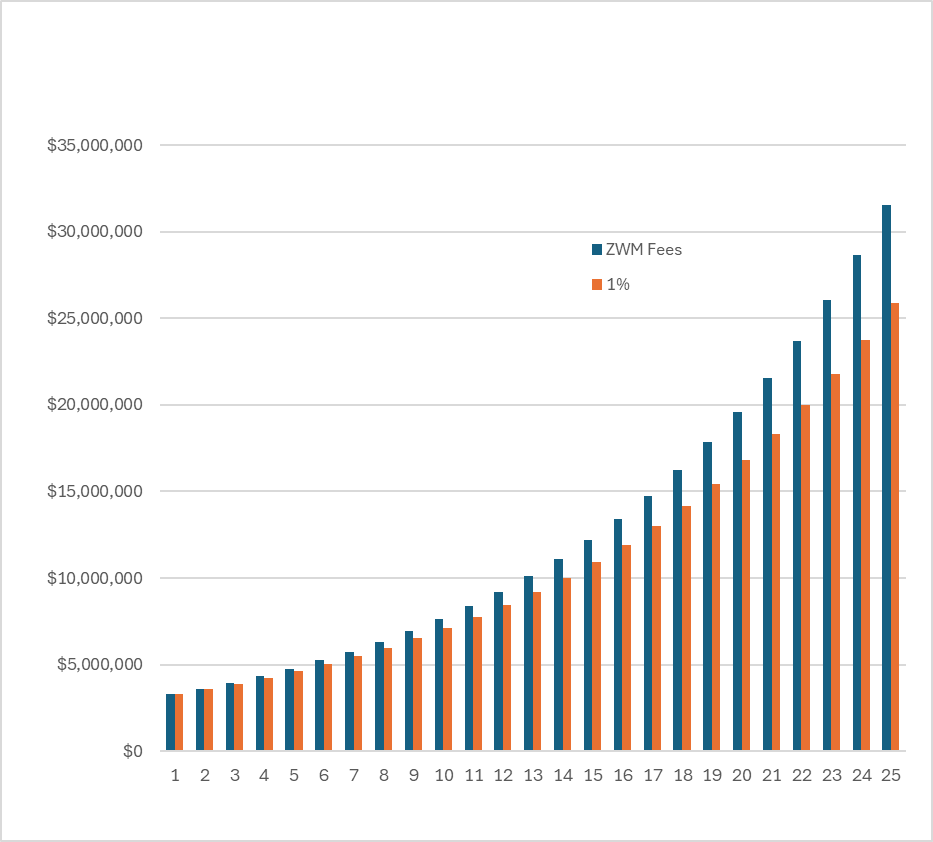
As you can see, the savings can be substantial. Hopefully this gives you some insight into the benefits of working with a flat fee advisor. I suspect more advisors will try to get into this niche as the years go by. If you want to work with someone, I truly think this is the way to go. Not only does it offer tremendous value from a fee aspect, but the clarity if what you are paying is there. If you like what you just read, please reach out to schedule time to chat at no cost to see if working together might be a good fit or if you have any questions.
